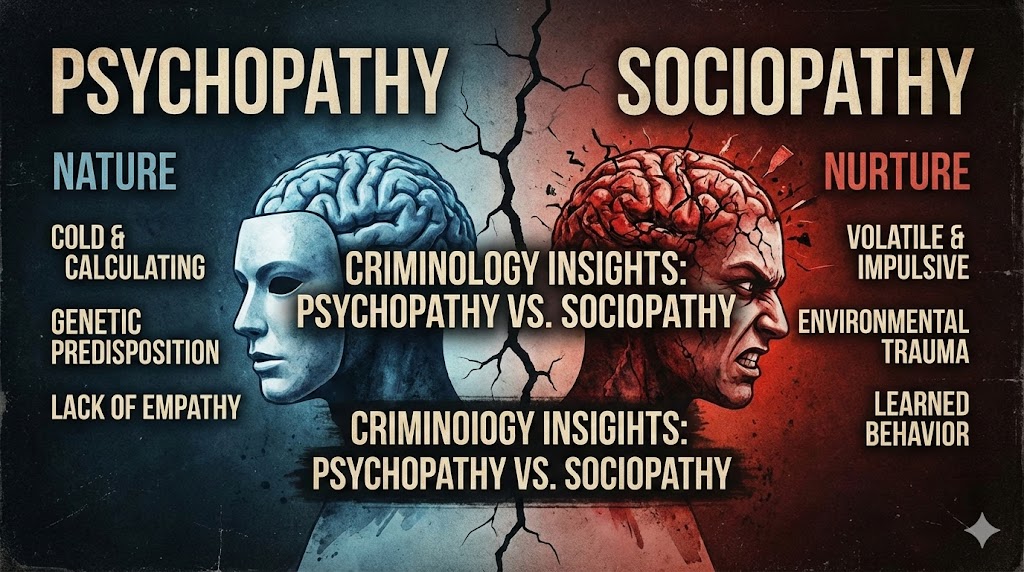
- Psychopath vs. Sociopath: What Is the Real Difference Behind the Criminal Mind?
 Confusion between these two terms is very common because, clinically, both typically fall under the same diagnostic umbrella in the DSM-5 (Diagnostic and Statistical Manual of Mental Disorders): Antisocial Personality Disorder (ASPD). However, in the fields of forensic criminology and criminal psychology, the distinction is vital because it helps predict the subject’s dangerousness, recidivism, and… Read more: Psychopath vs. Sociopath: What Is the Real Difference Behind the Criminal Mind?
 - Clever Hans Effect
 The Clever Hans Effect (or Handler/Experimenter Bias Effect) is a psychological phenomenon illustrating how the involuntary expectations and cues of an experimenter, handler, or audience can subtly influence the behavior of a subject (animal or human), causing them to produce the expected result without actually possessing the attributed skill. The name comes from the famous… Read more: Clever Hans Effect
 - The Dark Triad
 The Dark Triad of Personality is a central concept in personality psychology that groups three subclinical personality traits—meaning they manifest in the general population and do not necessarily constitute a mental disorder—that possess malevolent qualities: Narcissism, Machiavellianism, and Psychopathy. This construct was formally established by researchers Delroy L. Paulhus and Kevin M. Williams in a… Read more: The Dark Triad
 - Modern Anomie
 The Existential Void Behind Urban Crime Urban crime isn’t always born out of hunger, revenge, or greed. In 21st-century major cities, its roots are often more invisible: loneliness, lack of purpose, the breakdown of community, and disillusionment with society. This phenomenon, described by sociology as anomie, has evolved over time into a form of modern… Read more: Modern Anomie
 - Between Morality and Law
 Why Some Crimes Are Culturally Accepted Law and morality do not always coincide. Some acts are criminalized in the penal code but, in social practice, receive tolerance, justification, or even moral approval in certain contexts. Understanding why this happens requires a simultaneous look at history, power structures, cultural norms, psychological mechanisms, and the way rules… Read more: Between Morality and Law
GENERAL
Hello, I’m
Martha Conill

Welcome to Crimiphobia, my personal space where I post interesting information and the knowledge I’m learning about the world of criminology. I invite you to explore my page and discover very interesting things, facts you didn’t know, interview transcripts, information on the most wanted criminals, unlimited debates, and a good dose of criminological knowledge. Come in, we don’t bite!
Let’s connect
Fact #1
Punishment does not correct, it creates criminals